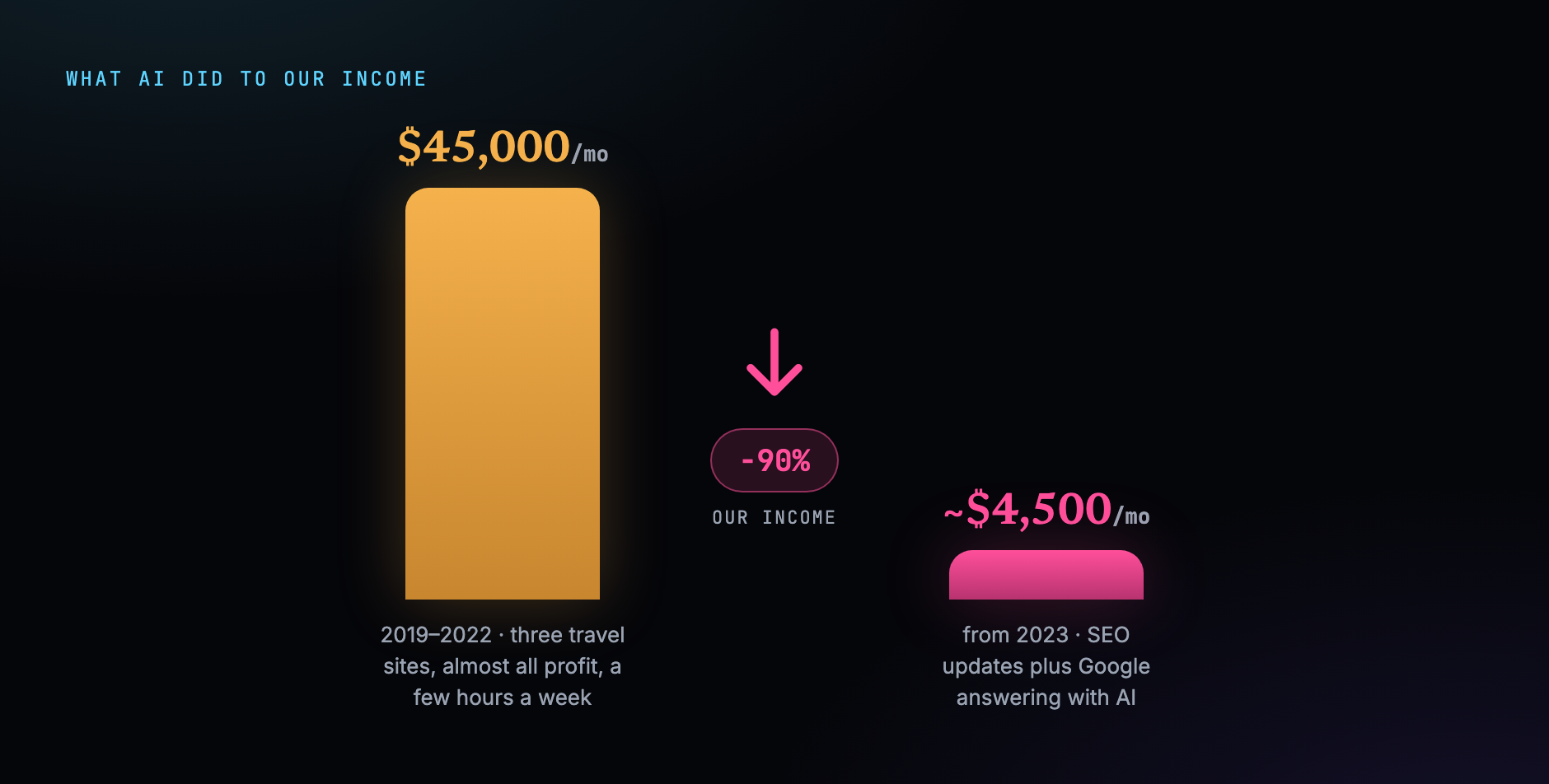
In 2019 my three travel websites made about $45,000 a month. Almost all of it profit, for maybe a few hours of work a week.
By 2023 they were making roughly a tenth of that.
Google changed how it ranked pages. AI started answering people’s questions before they ever clicked an article. The open web filled up with AI-written content. The traffic that paid my bills was mostly gone inside a few months.
I spent about two years pissed off about it. Now I am doing the opposite. I am learning to build with the same technology that cut my income, and this is day one of it.
So if you are new here, I am Nick.
My fiancée Dariece and I have run content sites for about fifteen years. They paid for a lot of travel and a life where I mostly work off a laptop.
I am 41, I have never written a real line of code, and a year ago I would have called “agentic AI” a buzzword and scrolled past it.
So here is where I actually am right now. What happened to the money, the one tool I would tell you to use, the mistakes that already cost me real cash, and the three little agents I have built so far. The video walks through the whole journey. Down here is the part you can actually use.
What AI actually did to our money
I want to put a real number on this, because the number is the point.
When people say AI hurt their business, you picture a guy who lost a couple hundred bucks a month on a side hustle. That was not this.
Three things landed at once.
Google changed its algorithm and buried independent blogs under the big brands. It also started answering questions right at the top of the page with its own AI summary, so people got the answer and never clicked through.
At the same time the open web filled up with AI-written articles, so whatever clicks were left got split between ten times as many sites.
Search almost any travel question now and you can watch it happen.

If you run a site, you can check whether this is hitting you in about ten minutes. I would do it today.
Open Google Search Console and put the last six months next to the six before it. Look for impressions holding steady while your clicks drop.
That gap means you are still ranking fine. Google is just answering the question before anyone gets to you.
Then take your ten best money keywords and search each one in a private window. See how far you have to scroll past the AI answer and the ads to find your own link.
If you have to scroll at all, that traffic is already leaking, and writing more posts the old way will not fix it.
Why I stopped being pissed off and started learning
For about two years my whole plan was to stay angry.
I had a tidy little retirement mapped out. I would sit at a laptop and write these blogs until I was 70, because it is work you can do with a coffee and an ocean view and a body that has stopped cooperating with anything athletic.
That plan is dead. Being angry about it did not pay a single bill.

So I made a different call.
Instead of being the 41-year-old who is scared of AI and waits for it to take the rest, I want to be one of the people who learns to drive it.
I do not mean poking at ChatGPT like a search box. I mean building actual agents that go off and do real tasks for me while I do something else.
If your job or your business sits anywhere near the path of this, the move is the same. Stop reading articles arguing about whether AI is going to take your job. Spend one weekend pointing it at a real task you already do every week.
The fear shrinks fast once the thing is doing your busywork.
I am writing this for the over-40 crowd especially. We came up before any of this, and we can feel the ground moving. I am learning it in public at your speed and writing down every wrong turn so you can skip it.
Don’t buy the Mac mini yet. Use Claude Code.
When I started, the loud advice online was to go buy a Mac mini and run a tool everyone was calling Open Claw.
It lets AI agents take over a computer and actually do things. Write emails, search the web, build stuff, instead of just chatting back at you.
Everyone was buying a dedicated machine to run it, so of course I did too. I unboxed the Mac mini, set the whole thing up, and it blew me away.
Then the bill started climbing. The reason why is the most useful thing I can tell you in this whole post.
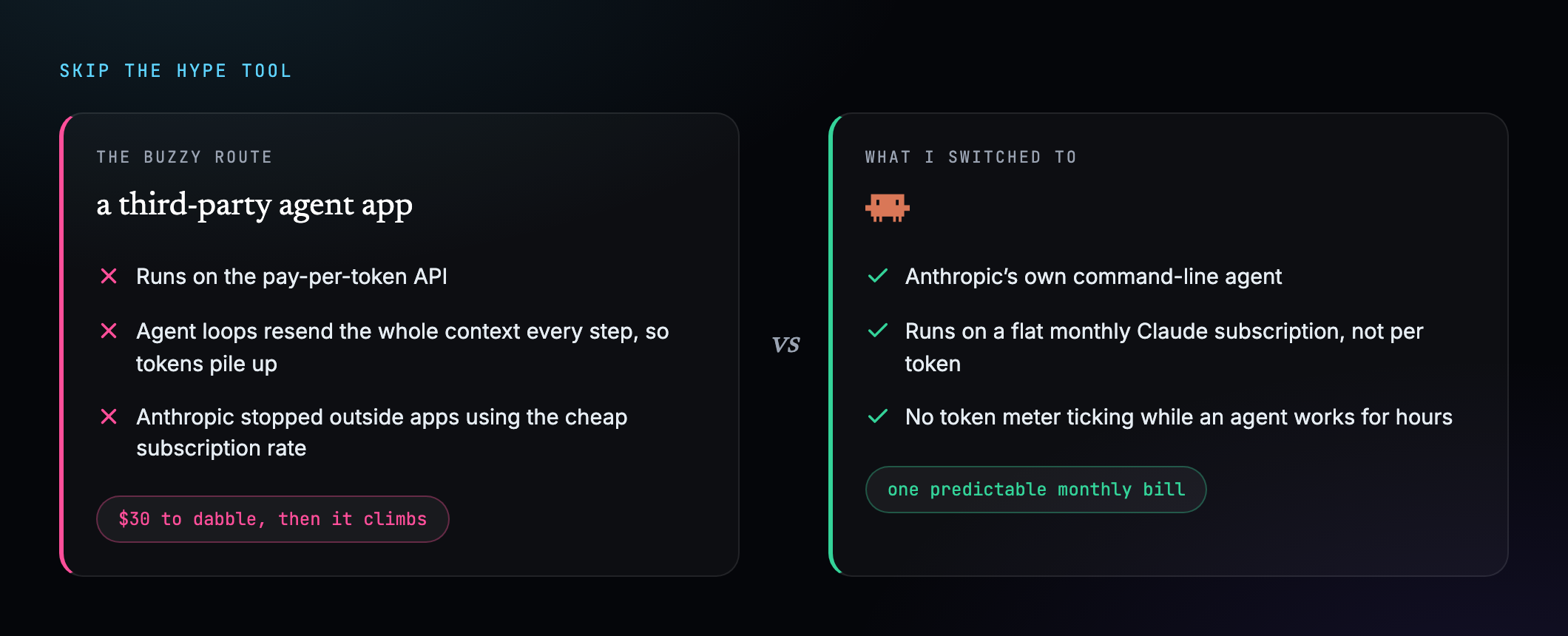
Tools like that run on the pay-per-token API. You get billed for every word of text the AI reads and writes.
That sounds cheap until you remember how an agent works. Every step it takes, it re-reads everything it has already done. So the token count climbs fast the longer a job runs.
On top of that, Anthropic stopped letting outside apps use the cheaper subscription rate, which pushed those tools onto full API pricing.
So I switched to Claude Code. It is Anthropic’s own command-line agent. It still takes over the machine and runs agents for me, but it runs on a flat monthly Claude subscription instead of a meter.

If I were you, here is what I would actually do.
You do not need the Mac mini to start. Run Claude Code on the laptop you already own.
Put it on the Max subscription instead of the pay-per-token API. An agent that grinds away for an hour on a subscription is just part of one flat monthly bill. That same hour on the API is a meter running the entire time.
If you do end up on the API, the rough shape is a few dollars per million words in, and a bit more per million out. An agent re-reading its own work will burn through that faster than you would guess.
A quick rule of thumb. If you are going to run agents for more than a few minutes a day, the flat subscription pays for itself almost immediately.
The one real reason to put it on a separate machine is safety. You are handing an agent permission to run commands on its own, and you do not want it doing that on the computer that has your whole life on it.
The $25 mistake I made in 5 minutes
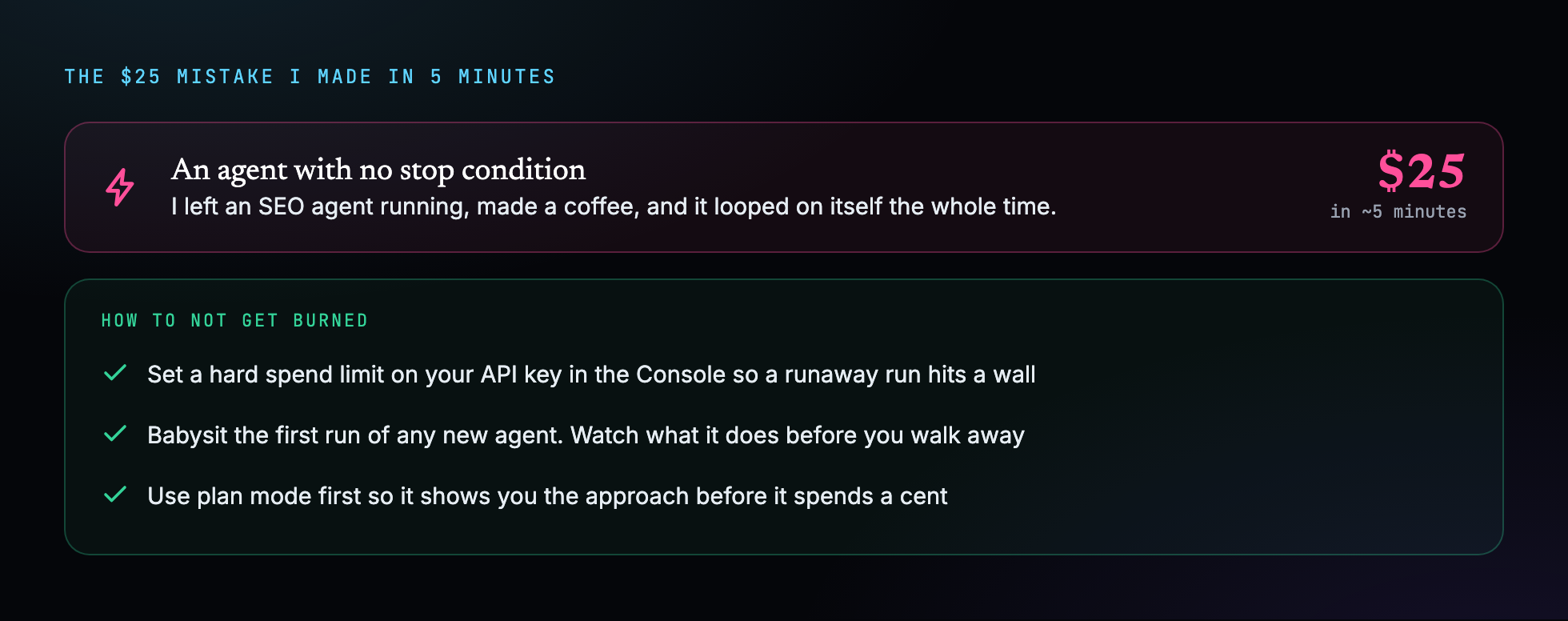
My first real lesson cost me $25 in about five minutes. You can have it for free.
I had built an agent to do my SEO research. It was working great, so I set it running and went to make a coffee.
While I was gone it got stuck in a loop, doing the same step over and over, every pass costing money. I came back to a $25 charge for a job that should have cost pennies.
An agent does exactly what you tell it, including “keep going,” with no instinct to stop and ask whether this is stupid.
So three guardrails go on every new agent I build now.
First, set a hard spending limit on your API key in the Console, so a runaway can only do so much before it hits a wall.
Second, babysit the first run of anything new. Watch what it actually does before you trust it enough to walk away.
Third, and this is the one I lean on hardest, use plan mode. You type what you want, and Claude Code lays out every step it is going to take before it runs a single one. You catch the expensive dumb idea while it is still just words on a screen.
Three agents I built in a few days
In the first few days I built three of these things.
The part that still gets me is that I built them by typing in plain English, not a line of code. I described each job the way you would brief a new assistant, and Claude Code worked out how to actually do it.
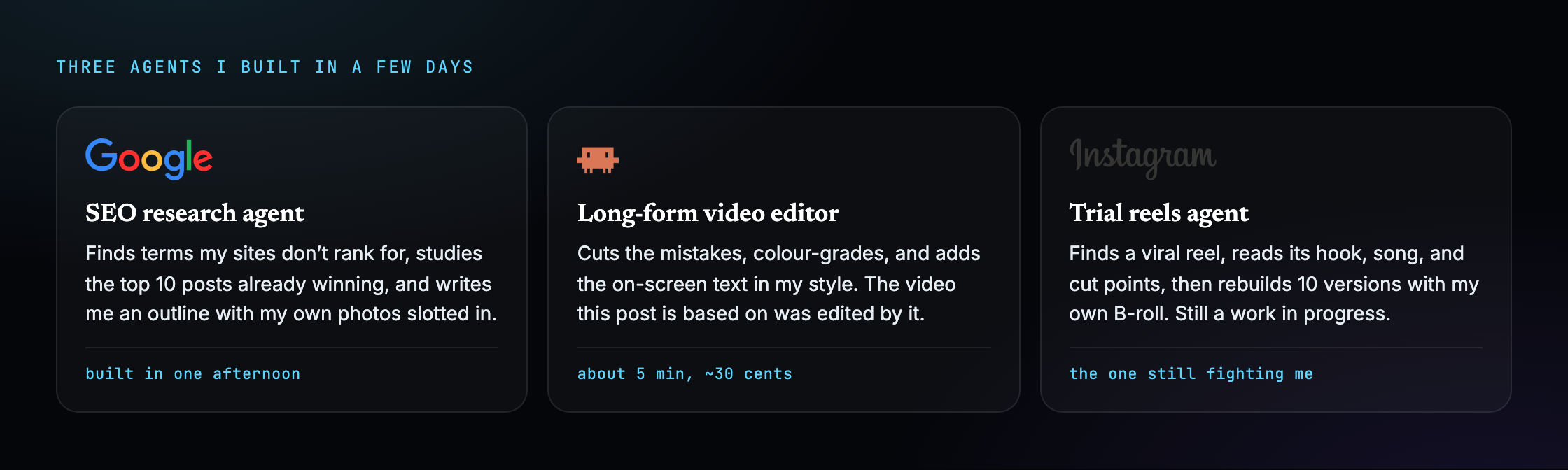
The first one finds keywords my sites do not rank for yet. It studies the top ten posts already winning those searches, figures out what they did right, and hands me a full outline with photos from my own library dropped in. I built it in one afternoon.
The second one edits my long-form videos. It cuts the mistakes, colour-grades the footage, and adds the on-screen text in my style. The video this post is based on was edited start to finish by it, in about five minutes for roughly thirty cents.
The third one hunts down viral Instagram reels. It reads the hook, the song, and where the cuts land, then rebuilds ten versions with my own B-roll. That one is still bad, and I am leaving it bad on purpose so you see the real state of this and not a highlight reel.
To make that real, here is roughly how I briefed that first SEO agent. Just plain sentences:
“Here is the login to my WordPress site. Look at my published posts, find the ten topics where I am stuck near the bottom of page one, pull up the posts beating me on each one, and write me an outline that would beat them. Only use photos already in my media library.”
I never told it which programming language to use or which tool to grab. I gave it the outcome and the steps I would take by hand, and it figured out the how.
When it screwed something up, I fixed that one thing and told it to remember the rule next time.
If you want to build your own, there is no trick to it.
Pick one boring task you do every week. Describe it to Claude Code like you are training a person, including the steps you think are too obvious to bother saying. Those are exactly the ones it needs.
You describe it, you watch it run, you fix what broke, and you do that until it works. That loop is the whole skill, and everything I have built so far is the same loop pointed at a different job.
Where this goes
This is day one, and I am being straight about that.
I am not doing this to crank out AI slop and pile more of it onto the same web that buried my sites in the first place.
What I want is agents that do real work, save me a dozen hours a week, and turn into something I can hand to other people who are stuck where I was. If that works, it rebuilds the income AI took, and maybe more.

I am filming and writing the whole climb here, the wins and the $25 screwups both. I am a 41-year-old who cannot code, working it out one agent at a time.
If AI has already come for your income, or you can see it coming for your work, this is where I am writing it all down.
Come along for the ride.